



The benefits and meaning of pallet markings
Have you ever wondered what pallet markings mean? Pallet codes are essential for showing compliance with specific regulations and for making it easier to control, handle and manage the flow of goods.
Read on to find out what pallet markings and codes mean, what ISPM 15 pallet marking is and how pallet marking can benefit your business.
What pallet markings mean
The meaning of pallet markings depends on the type of seal, code, logo, symbol, certification or label applied to identify ownership, origin, treatment and the characteristics of each pallet.
It is a process that involves engraving, painting or stamping a unique identifier onto each pallet of goods to make tracking, management and traceability easier throughout the supply chain, while also ensuring compliance with sector-specific and phytosanitary regulations.
What pallet codes mean
If you ship pallets on a regular basis, you’ll know there are different types of codes. These are the most common:
- Treatment codes: These indicate the type of treatment the pallet has undergone to prevent pests, for example HT (heat treatment using a conventional steam chamber or kiln drying), DH (dielectric heating treatment), MB (methyl bromide treatment) or SF (sulphuryl fluoride treatment).
- Identification codes: These identify the pallet type according to global logistics standards, for example EPAL (standardised European pallets), EUR-UIC (standardised pallets for European rail transport) or GMA (a standard used in North America).
- Logos and ownership marks: These indicate that the pallets are the exclusive property of specific companies, for example CHEP, LPR or IPP.
- Sector-specific codes: Some pallets also carry additional markings to comply with regulations in the sector in which they are used, for example FSC or PEFC pallet certification codes.
Explaining ISPM 15 marking on pallets
The International Standard for Phytosanitary Measures (ISPM 15) is a regulation developed by the Food and Agriculture Organization of the United Nations (FAO) to reduce the risk of introducing or spreading pests through the use of wood packaging in international trade.
To comply with ISPM 15, a wooden pallet must undergo two mandatory processes: namely, phytosanitary treatment and marking.
Types of phytosanitary treatment
Phytosanitary treatment is the procedure that must be applied to pallets to disinfect them. The standard includes several different treatments:
- Heat treatment using a conventional steam chamber or kiln drying (HT): This involves heating the wood until it reaches a minimum temperature of 56°C for at least 30 continuous minutes throughout the wood profile, including the core.
- Heat treatment using dielectric heating (DH): The wood packaging must be heated until it reaches a minimum temperature of 60°C for 1 continuous minute throughout the wood profile, including the surface.
- Methyl bromide treatment (MB): Fumigation of wood packaging with methyl bromide must follow a protocol specified or approved by the National Plant Protection Organization (NPPO).
- Sulphuryl fluoride treatment (SF): This must also follow a protocol specified or approved by the NPPO.
ISPM 15 marking on pallets
Pallets that have undergone one of the treatments above must carry a mark certifying this. This mark must include the following elements:
- Symbol
- Country code (XX)
- Producer/treatment provider code (000)
- Treatment code: HT, DH, MB or SF (YY)
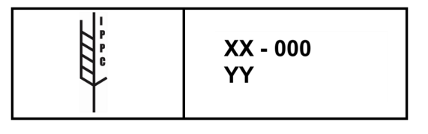
ISPM 15 marking template
In addition, the mark must meet certain formal requirements. For example, it must be rectangular or square in shape and enclosed within a border, with a vertical line separating the symbol from the code elements.
EPAL and EUR-UIC pallet markings and codes
EPAL and EUR-UIC are codes used to identify two types of pallets with very similar technical characteristics in terms of dimensions, strength and wood quality, but managed by two different organisations:
- EPAL: Standardised European pallets that comply with the dimensions defined by the European Pallet Association e.V. (EPAL).
- EUR-UIC: Standardised pallets for European rail transport manufactured in line with the specifications of the International Union of Railways (UIC).
These two standards have no longer been officially interchangeable since 2013, although they are still technically compatible.
Why pallet markings and codes matter for your business
Pallet markings and codes are mandatory for businesses that must comply with specific regulations, such as phytosanitary rules. In these cases, a lack of knowledge or failure to comply can lead to logistics delays, penalties or even the return of the shipment.
Using pallet markings and codes is not just about regulatory compliance. It also brings many benefits for businesses. For example:
- It helps ensure goods are handled correctly during transport and storage.
- It makes inventory management easier.
- It improves coordination between everyone involved in the supply chain, such as suppliers, distributors and logistics operators.
- It streamlines key business activities, such as order picking, purchasing processes and distribution.
Ultimately, pallet markings and codes help ensure compliance while also giving businesses a competitive advantage.
If you need more information about what pallet markings mean, or you want to ship pallets with clarity and control in a transparent and cost-effective way, get in touch with us.