

Fruit and vegetable transport is strongly influenced by seasonality. In Spain, the peak export season brings both challenges and opportunities for the logistics sector. Road transport demand increases sharply, while companies must continue to meet environmental standards and comply with strict industry regulations.
Spain is the leading producer of fruit and vegetables in the European Union and the eighth largest worldwide.
Each year, the country produces an average of more than 25 million tonnes. In 2024, the sector reached a value of over €18 billion. More than half of this production is exported, making Spain the world’s second largest exporter by value.
 Peak season vs low season: how export volumes change
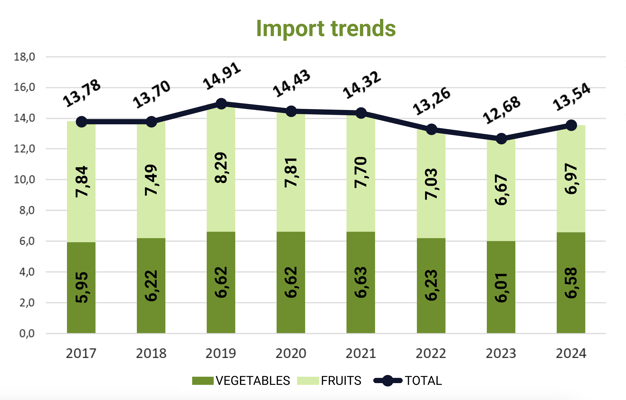
To understand how road transport demand shifts during the fruit and vegetable peak season in Spain, it helps to look at recent export figures. In 2024, Spain exported 12.3 million tonnes of fruit and vegetables, worth €17.7 billion. More than 95 percent of these exports were destined for the European Union.
According to Fepex, Spanish Federation of Associations of Producers and Exporters of Fruit, Vegetables, Flowers and Live Plants, 94 percent of Spanish fruit and vegetable exports are transported by road, meaning by truck.
This seasonal surge in road transport demand forces fruit and vegetable transport companies to mobilise vehicles and resources from other countries to Spain.
One of the main challenges they face is managing this temporary shift in vehicle availability. Trucks that usually operate in other markets must be reassigned to cover the peak demand for road transport in Spain.
Even when carriers have enough capacity to meet this demand, another major challenge remains: securing return loads. Avoiding empty miles is essential to reduce carbon emissions, optimise vehicle use and improve profitability.
One effective way to address empty trips is to use a logistics management system like CtrlChain. Carriers can manage their entire truck fleet in one place and find return loads more easily, with clear operational and sustainability benefits.
 Where Spanish fruit and vegetable exports go
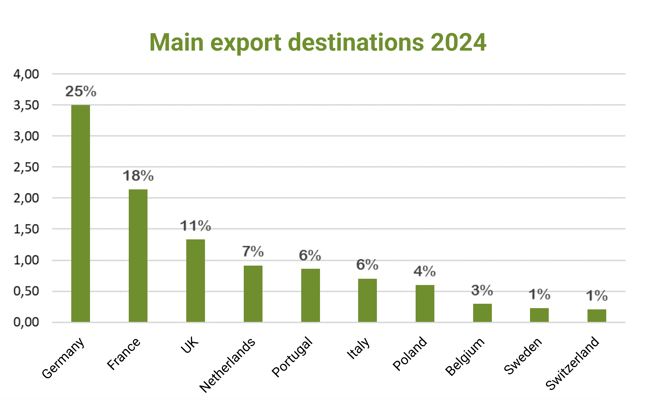
To better understand the challenges of peak season for road transport, it is essential to look at the destinations of Spanish fruit and vegetable exports.
These are seasonal products that must reach their destination as quickly as possible and under the right transport conditions. This requires strict compliance with regulations and careful attention to the specific needs of each product.
In 2025, the main importers of Spanish fruit and vegetables, particularly within the European Union, were:
- Germany, which imported around 1.89 million tonnes in the first half of 2025, making it the leading EU destination.
- France, which received approximately 1.18 million tonnes during the same period.
- The United Kingdom, one of the main markets, with around 0.74 million tonnes of Spanish fresh produce.
- The Netherlands, which continued to be a key EU destination with significant import volumes.
- Italy, which, despite lower figures, remains an important European market for Spanish fruit and vegetables
These figures highlight the strong focus of Spanish exports on European markets, which accounted for 84 percent of total export volume in the first half of 2025.
This shapes the reality for fruit and vegetable transport companies during peak season. Demand from neighbouring countries increases, driving a sharp rise in the need for road transport, the preferred mode within the industry.
In addition to allocating a large share of their truck fleet to cover this demand, carriers must also ensure their vehicles are properly equipped for transporting perishable goods.
Optimal conditions for road transport of fruit and vegetables
Transporting perishable products such as fruit and vegetables by road requires specific vehicle conditions. In general, four key aspects must be carefully managed:
The cold chain in road transport
From the moment fruit and vegetables are harvested, they begin to deteriorate. The purpose of the cold chain is to slow this process and ensure products reach consumers in the best possible condition.
To guarantee that goods are transported at the required temperature, which varies depending on the product, temperature-controlled transport is essential.
With CtrlChain, shippers can specify the required transport temperature when booking a shipment, helping to ensure the cold chain is maintained throughout the journey.
Strict delivery times
Punctuality is always important in logistics, but for fruit and vegetables it becomes critical.
As seasonal products with limited shelf life, delivery times must be closely monitored, taking into account the specific characteristics of each type of produce.
The CtrlChain dashboard allows real-time monitoring of all shipments, with driver updates and full visibility to ensure delivery deadlines are met.
Technology in transport
There are several ways to protect the cold chain and delivery times when transporting perishable goods. These include monitoring technologies such as temperature sensors and tracking devices, as well as refrigeration solutions like refrigerated or insulated trucks.
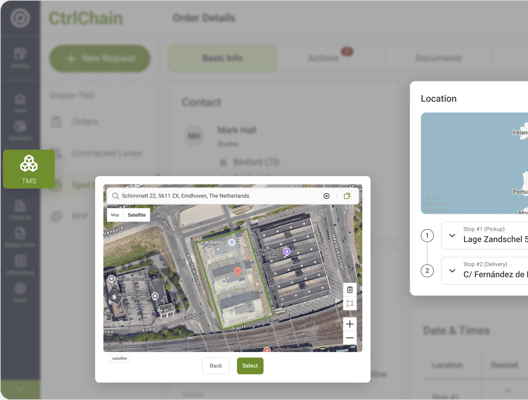
Logistics management systems also play a key role in optimising road transport. With CtrlChain, managing a truck fleet becomes faster and more efficient, saving time and providing clearer visibility across the supply chain.
 The importance of traceability
In the fruit and vegetable sector, traceability refers to visibility across every stage of the product journey, from harvest to final delivery.
In transport, this visibility is not just a value-added feature. In many cases, it is a legal requirement.
CtrlChain makes traceability straightforward. All the necessary information is easily accessible in the dashboard, supporting transparency and compliance when handling perishable goods.
Regulations for transporting perishable goods in Spain
At European level, the Agreement on the International Carriage of Perishable Foodstuffs and on the Special Equipment to be Used for Such Carriage, known as the ATP, has been in force since 1970 and in Spain since 1976. This agreement forms the basis of road transport regulation for perishable goods.
The ATP defines what qualifies as a perishable product, sets minimum transport conditions such as temperature and handling requirements, establishes mandatory documentation throughout the supply chain and outlines penalties for non-compliance.
In 2024, technical updates were introduced to the ATP, affecting transport equipment and vehicles. Annexes 1 and 2 were revised, including testing methods, inspection reports and technical specifications for insulated, refrigerated and mechanically refrigerated units. These updates aim to improve efficiency, sustainability and technological adaptation in temperature-controlled transport.
At national level, Spain implements the ATP through Royal Decree 1202/2005, supported by additional regulations such as Royal Decree 237/2000, which defines vehicle types and inspection procedures, and Regulation 852/2004, which sets requirements for food safety and traceability.
The 2024 ATP updates are reflected in vehicle and equipment certification processes in Spain, ensuring that European standards are fully applied at local level.
A season full of opportunity
The peak fruit and vegetable season in Spain represents a major opportunity for both carriers and shippers. Success depends on early planning, the right tools and technologies, and making the most of the strong increase in road transport demand.